STONETOWN INFORMATIONS
StoneTown
"It is a city of brilliant sunshine and purple shadows; of dark entries and latticed windows; of mysterious stairways, and massive doors in grey walls which conceal one does not know what; of sun-streaked courtyards and glimpses of green gardens; of barred windows and ruined walls on which peacocks preen. It is a town of rich merchants and busy streets; of thronged market-places and clustered mansions. Over all there is the din of barter, of shouts from the harbour; The glamour of the sun, the magic of the sea and the rich savour of Eastern spice. This is Zanzibar!" (Major FB Pearce, 1919)
Stone Town is a place to get lost in – lost in direction, but also in the fantasies of its intriguing past. A past filled with contradictions; the darkest horror of trading with human beings – the slave trade, the scrambling for the interior Africa by explorers and exploiters, the sultans and their harems, the wealth in gold, ivory and clove fortunes, the power of a strategic location and its diplomacy. The rich Swahili culture is uniquely visible in Zanzibar.
Zanzibar Stone Town, or the 'Old Town' as the name reads in Swahili, has a rich and delicate history which can be told in many versions. The mix of imprints from its ancient visitors until today has gained the place its exclusive reputation. Its unique cultural heritage has rewarded it a position among the World Heritage sites and thus in need for careful preservation and conservation. Learn more about Stone Town's history, architecture, and the threats the modern world poses to the town.
More Informations About StoneTown
Stone Town Architecture
Stone Town's architecture is as unique as its history. The town itself is a living monument to the centuries of cultural fusion and trade that shaped the nation. Doors
Doors
Perhaps the most striking and spectacular impression of Stone Town for its first time visitor is the magnificent wooden doors serving as grand entrances to the grand buildings.
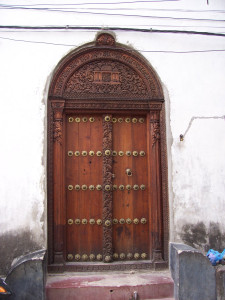
The doors have become more or less synonymous with the Swahili culture in East Africa, Lamu and Mombasa (Kenya) and in Zanzibar. Zanzibar has more and more elaborate doors than on the mainland and thus the doors are named 'Zanzibar doors'. An inventory done in the 1980s reported around 800 doors. Unfortunately has the number decreased, not only due to the diminishing of several houses, but also due to theft following the increased attention from international collectors.
The doors demonstrate unsurpassed technical and artistic craftsmanship. Wealthy traders and house owners appointed skilled carvers brought in from India for the delicate job of arranging the entrance ornament. The oldest doors are often made out of Burma (Indian) teak, shipped all the way from Asia across the Indian Ocean. The shutters are made in one impressive piece and not mended together as is the case on newer doors. The Burma teak no longer exists, so newer doors are made of East African teak. Even this wood has become rare and difficult to find, often demanding a very high price.
In principal there are two types of doors found in Stone Town. The Indian doors, or Gujarati doors, with square shutters and made into smaller sections so that the door can fold together. These doors are to be seen along the busy bazaar streets where the Indian businessmen lived. The second type is called 'Arab doors', these doors are often found with an inscription in Arabic – most likely a phrase from the Holy Quraan – on the top frieze, and richly decorated around the frame. The older doors were all square at top. The semi-circular frames were introduced later, but are still referred to as 'Arab doors'. The custom of putting brass knobs on the shutters comes from India, where the knobs were said to prevent elephants from crushing the doors. Since there have been no violent elephants in Zanzibar the brass knobs were simply but there as a decoration and to show the wealth of its owner.

By looking at the lower part of the side posts a rough estimate can be done of the age of the door. The oldest doors have a symbol resembling of a fish. The fish gradually transformed into a shape of a pineapple and thus if the carving shows a clear and distinct pineapple the doors is of a newer generation. Another symbol that became part of the decoration was the chain-like row at the very outside of the whole door. The chain was said to protect the entrance from evil spirits. One of the oldest doors in Stone Town can be found at the entrance to the Old Fort. Another one is the well maintained door at the Zanzibar Conservation Centre (former Old Customs house) along the Forodhani seafront (See Landmark Buildings).
Stone Walls
Try to use a modern cell phone inside a traditional Stone Town building. The reception will fail and the call will never get connected. The average thickness of a wall in Stone Town is 40 – 60 cm. The building material used is coral rag and lime mortar, an appropriate technology for a hot and humid climate where heat needs to be kept out and humidity varies over the seasons. When the monsoon swept in over Zanzibar the walls managed to absorb the dampness. The material in the walls could expand. When the hot and dry season entered the walls dried out and the heat was kept at bay.
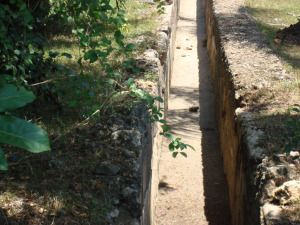
Due to neglect and poverty many buildings have already collapsed in Stone Town. The sad remains of those crumbled houses show the handsome work of the walls interior. The coral stones and mixed with sand and mortar, holding the construction together.
Floors, ceilings and roofs
Most rooms found in traditional houses in Stone Town are quite narrow and deep. This is because traditionally, floors and ceilings were made with mangrove poles, which only grow a certain length. Only in houses where imported teak could be afforded, and in later constructions where iron beams were introduced, are the rooms wider and more spacious. Lime mortar was also used for the floors and ceilings giving the same flexibility to building as the walls. The height from floor to ceiling was generous and made it possible for the air to circulate and cool off. Initially the houses had flat roof with a crenel around the top. When corrugated iron was introduced to the Island, many houses got an additional pitched roof on top.
Zanzibar louvers and other details
The windows in the Stone Town buildings are also worth some attention. They often stretch from floor and high up the walls, with deep niches protecting the inside room from direct sun-light. The lower part at floor level had separate shutter that could open and helped to increase the ventilation in the rooms – once again an appropriate construction for the humid climate. The special louvers, even named 'Zanzibar louvers', at the mid part or upper part of the windows have a vertical stick in the middle making it possible to change the angles of the louvers. This finesse made it possible to open for maximal light and air and then close for privacy and shade.
The Arab houses had in general plane facades with windows giving the inhabitants the possibility to look out but no one from outside could look in. The Arab women were not supposed to be seen in public and hence there are often no outdoor sections of these houses. Still, several houses can be found with the most beautifully decorated verandas. Some of these houses have had their balconies added later or the houses were built by Europeans or non-Arabs. The Zanzibar Conservation Centre (the Old Customs House) is one example of an Arab-mansion that has had its significant veranda some thirty years after its original construction.
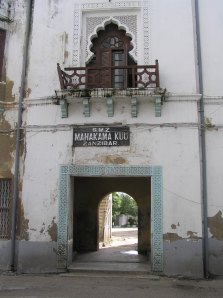
A typical detail at the houses in Zanzibar are the stone benches either outside the house or seen in the first hallway when looking in from the main entrance door. These benches, or sitting arrangements, are called 'baraza' in Kiswahili and a symbol for the rich social life in the Swahili culture. The outside baraza benches are often found in the merchant part of Stone Town were business could both discussed and displayed openly. In the Arab houses the baraza benches are find inside. In the more prominent Arab houses there was even a second 'Zanzibar door' in the hallway leading to a room where guests could be invited for more private discussions. Black and white marble tiles found on the stairs and entrance to a house is yet another sign of wealth and importance of its owner.
It is estimated that Stone Town today has about 1700 houses; a good number of them are unfortunately in a poor stage and in immediate need of repair. A survey done in 1992 showed that almost 25% of the houses were Government property, about 20% belonged to a religious Trust Commission (Wakf), and nearly 50% were privately owned, leaving about 6% as unknown property.
Stone Town History
Stone Town is as old as the first told stories of its Island. The first Arab sea traders are said to have mentioned the 'Coast of the black people' – the land of Zenj – from which the name Zanzibar is believed to have come from. The Island's strategic and accessible location along the East African coast turned it into cosmopolitan centre where Arab, Indians, Europeans and African traditions and cultures all got merged together.
The first settlement and the oldest today known in Stone Town is the Portuguese fort. Its foundation was laid down in the early 18th century, but probably not finalized until late 1780, by the Omani rulers, thus more correctly being a Omani fort. The most significant part of the Stone Town is made up of the dominant Arab houses. These buildings, often square and with a spacious inner courtyard allowing light and air to circulate in the house, were built closely together not considering the need of any fencing and/or garden around them. The Arab families were used to stay close to each other and many of the buildings were connected via walkways, like bridges, still seen on the first floors This arrangement made it possible for the female members of the family to go and visit relatives and friends without having to enter the streets. By just leaving room for narrow streets in between the often tall houses helped to make sure there would be a shadow for those walking in the streets. Still the wind from the sea was allowed to blow though and give some comfort during hot days.
Stone Town became a flourishing centre of trade in the 19th century. It was a hub for the trade of both spices and human beings. The ruling sultanate had a close relationship with the British; in 1890, Zanzibar became a British protectorate. The Zanzibari Omanis rebelled against British rule in 1896. The resulting Anglo-Zanzibar Water is known as the shortest war in history, lasting just 45 minutes of marine bombardment by the British Royal Navy before the Sultan was forced to surrender.
Issues And Threats
Stone Town's listing as a World Heritage Site proves its fascinating heritage and value to the people of the world. A site this important must be maintained, preserved and cared for. Unfortunately, there are many threats to the proper preservation and maintenance of Stone Town. Recently, in October 2012, the House of Wonders, one of Zanzibar's most important heritage buildings, experienced a major collapse. Threats can be any of the following:
Development Pressures
Zanzibar's growing economy and Stone Town's attraction to tourists has many positive aspects. However, the resultant growing development puts a great deal of pressure on the buildings and environment of Stone Town. Increasing traffic is increasing demand for new parking areas within Stone Town. Sites of collapsed buildings are in danger of being used as parking areas. Furthermore the construction of new buildings, especially hotels, is a threat for Stone Town's unique appearance .Environmental Pressures
Stone Town's buildings are built with many traditional materials. While these materials are both more sustainable and more appropriate to the environment of Zanzibar, they are affected by environmental degradation. Rain makes the render peel away from walls, exposing the coral stone to the elements. The water weakens the lime mortar or washes it away. This can lead to the collapse of coral-stone buildings. The more recent phenomenon of global warming is another environmental. Through rising sea levels, all the buildings on the waterfront are in great danger. The rise in the sea water's temperature can change the climate and influence the weather and environment. The only thing the Heritage Society can do about this problem is to maintain and restore the old houses, so that they can brave the elements in the future.
Lack of Awareness and Support
One issue the Heritage Society is working on constantly is awareness creation. Stone Town residents need to be informed about the outstanding value of our heritage for the entire world. If the people can understand the value of their house, they have more motivation to maintain it. Above all to save Stone Town resources, training and qualified personnel is needed. Also traditional materials and craftsmen need to be available. This is a great challenge, because the traditional material is limited and sometimes of inferior quality. Furthermore the Zanzibar Stone Town Heritage Society needs funds to ensure the preservation works on Stone Town houses, which will save the heritage for future generations. These can only be granted by the government or by private donors.
What Can You Do?
You can help to keep the Heritage site clean, to maintain the houses and to inform your family and friends about the value of the World Heritage for their daily life. Also, you can donate to the ZSTHS, to help us create more restoration and training opportunities in Stone Town. A little help can go a long way
Land Mark
At present there are 26 landmark buildings in Stone Town, rated as Grade I buildings. A Grade I building is a building with outstanding architectural, historical or cultural significance.
The Old Fort
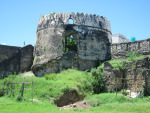
The Old Fort's foundation was laid by the Portuguese in early 1710s but the building was finalized in a Omani style in 1780. Was later used both as a prison by the British officials until 1950, and also as a railway workshop in the 1920s when the railway from Bububu to town was built. Now it is used as a cultural centre of Stone Town.
The House of Wonders – Beit el Ajaib
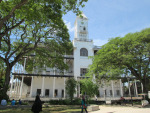
Built in 1883 by Sultan Sayyid Bargash for ceremonial purposes, but has also served as residence for one of his successors. After the revolution the building was used by the ruling party and in 2001 became the Museum of Zanzibar. In October 2012, the House of Wonders experienced a collapse in its southeastern corner. It has yet to be repaired.
The Persian Bath – Hamamni Bath – Kajificheni
The bath was built for the public by Sultan Seyyid Barghash (1870-88) and designed by an architect from Persia.The People's Palace – Forodhani Since the first Sultan Sayyid Said settled in Zanzibar 1832 the location for the palace has been along the seafront. The palace has had many shapes and gone through many alterations by the various reigns. In the aftermath of the bombardment in 1896 both the harem (Beit al-Hukm) and the palace (Beit al-Sahil) were badly damaged. Only the palace was rebuilt, and in a much smaller scale. In spite of its smaller size, architectural greatness is still visible in today's People's Palace.
Royal Tombs – Forodhani There are several Royal Tombs scattered about the Forodhani neighbourhood. The custom in old times was to have the burial sites close the homes. The Sultan's family is mainly buried in the vicinity of the palace.
Royal Baths – Forodhani A small Persian bath for the Sultan's family was built inside one of the palaces (Beit al-Tahin) – today Forodhani School.
The Market Building – Mkunazini Its original name was 'Sayyidieh Market', inaugurated in 1904 and designed by the British architect Sinclair. It was built on the first reclaimed land along what is now known as Creek Road, still having the creek at its back.
The Aga Khan (Jamatkhana) Mosque The present mosque of the Ismaili community is from 1905, even though the first construction was done already in 1838. The building is well maintained and has typical Gujarati style entrance door.
The Bharmal Building The building of today Municipal Council was built in 1923 on reclaimed land, by an Indian merchant who traded in tea. The building was also used by the British for the senior Government officials.
The Kilosa House – Shangani The origin of the building is unknown but its purpose was to serve as warehouse on the ground floor with lodging facilities on the first floor. It is still used for commercial purposes after its renovation in the mid 1990's.
The Mambo Msiige Building – near Kelele Square The Mambo Msiige is a building with a colourful past. It was built around 1850 by a wealthy Arab resident and the name means 'do not imitate' – giving a hint of its stunning design and architecture. The building was later used both as residence for British representatives, as the Universities Mission in Central Africa, as a European hospital and is today a Government office.
The Tippu Tip House – Shangani The Tippu Tip house was built by the renowned slave trader with the same name. It is not a traditional Arab house but still reflects the characteristic styles of other houses built in the late 19th century. This building is in an unfortunate state of disrepair.
The High Court Building – Vuga The High Court Building belongs to the group of buildings designed by the British architect Sinclair in the style defined as 'Saracenism'.
The Peace Memorial Museum – Mnazi Mmoja The Anglican Cathedral has much become a symbol of the end of the slave trade area. The foundation stone was laid down in 1873, the same year that the slave trade was officially abolished. The Anglican Cathedral is mainly build by cement and not lime mortar, and has tried to incorporate some Arabic features in its mainly Gothic design. It is said that Sultan Barghash donated the clock for the tower with the condition that the tower should not exceed the tower at the Beit el-Ajaib.
The Khoja Ismail Charitable Musafirkhana – Kiponda The Musafirkhana or Caravanserai in Kiponda was built to host travellers and visitors exclusively from the Khorja Ismail community. The two storey building had thirty-six individual rooms all facing a spacious open court yard and was completed in 1892.
The State House – Vuga Today's State House was designed as the British Residency and built in 1903. The building belongs to the group of buildings designed by the British architect Sinclair.
Mnazi Mmoja Hospital – Mnazi Mmoja The first part of the hospital was built in 1896 and had 6 Asian wards and 9 African. In 1924 an additional wing for Europeans was constructed. After the revolution the hospital was named IV Lenin Hospital for a while.
Tembo Hotel – Forodha Mchanga An Arab mansion built on the waterfront and in the 1990s renovated as a hotel.
Hindu Temple – Kiponda The temple is located just behind the People's Palace (Sultan's Palace) imbedded in a residential area and a bit anonymous. The temple is believed to have been built in the 1870s.
Minaret of Shia Ithnasheri Mosque – Kajificheni One of the few minarets belonging to the traditional mosques in Stone Town, built with clear influence from Indian mosques and dated back to 1894.
Chawl Building – Darajani Sultan Barghash decided on the construction of the Chawl building in an attempt to improve revenue to his Government. The ground floor was designed for shops and store area and the first floor as residential quarter. The building was built on the shore of the creek, stretching for about 100 metres from the Central market towards the bridge connecting town with the Ngambo area.
Former British Consulate – Forodha Mchanga The British Consulate was opened in 1841, strategically located in the commercial quarters but with the pleasure of the closeness to the sea. The building is said to have accommodated the famous explorers, Speke, Burton and Dr. Livingstone, at various times. In 1874 the C 0 onsulate moved to Mambo Msiige and the house was taken over by the Smith MacKenizie Company until 1974 when turned into a Government office.4
World Heritage Site
UNESCO awarded Stone Town with the World Heritage Site award in 2000 in recognition of its unique cultural and social importance. The status was awarded based on the following criteria:
Criteria
The Town of Zanzibar is an outstanding material manifestation of cultural fusion and harmonization. Mosques to churches, Indian temples to the Omani palaces and so forth are a testimony to the thousands of years of mutual tolerance among communities of different cultural origins. For many centuries there was intense sea borne trading activity between Asia and Africa, and this is illustrated in an exceptional manner by the architecture and urban structure of Stone Town.
Zanzibar has great symbolic importance in the suppression of slavery, since it was one of the main slave-trading ports in East Africa and also the base from which its opponents such as David Livingstone conducted their campaigns.
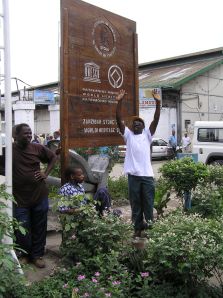
The World Heritage Convention The World Heritage Convention was adopted by the General Conference of UNESCO in 1972. The Convention Concerns the Protection of the World Cultural and Natural Heritage. To date, more than 198 countries have adhered to the Convention, making it one of the most universal international legal instruments for the protection of the cultural and natural heritage.
By fostering communications between managers and the exchange of know-how pertaining to the management of World Heritage Cities, the OWHC is helping to support public officials in the execution of the responsibilities that each government that is a party to the Convention has assumed by signing the agreement, i.e., to act as the key guarantor of the preservation of the sites and monuments included on the UNESCO World Heritage List located within its territory.
To learn more about UNESCO and other World Heritage Sites, visit UNESCO